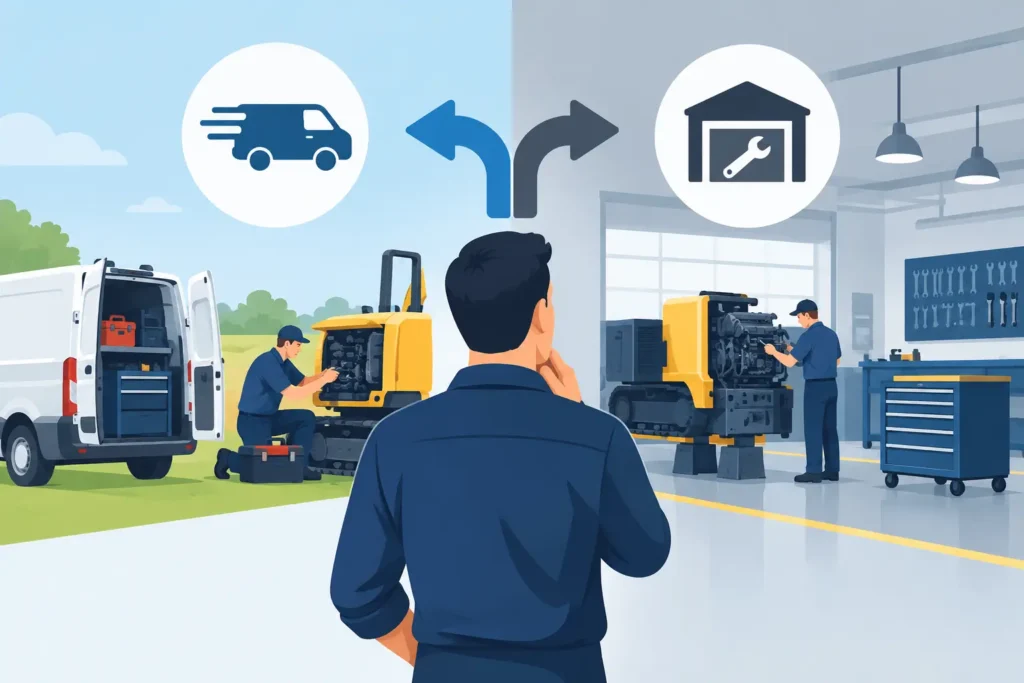
A dead excavator at the edge of an active dig, a loader with a hydraulic leak, or a truck that will not complete its route creates the same immediate question: should you call for mobile versus shop equipment repair? The right answer is not always the fastest-looking option. It depends on the failure, the machine’s location, site safety, parts availability, and what an hour of downtime will cost your operation.
For contractors, landscapers, haulers, and fleet owners around Ottawa, the goal is straightforward: get dependable equipment back to work without turning a repair into a longer delay. Mobile service can protect a schedule when a machine is stranded. Shop repair can be the better decision when diagnostics, lifting capacity, controlled conditions, or a more complete repair are required.
Mobile Versus Shop Equipment Repair: The Real Difference
Mobile repair brings qualified technicians, diagnostic tools, and common repair equipment to your job site, yard, or roadside location. It is built for situations where moving the machine is impractical, unsafe, or more expensive than sending a technician out. A field repair may include diagnostics, hose replacement, electrical troubleshooting, brake work, minor engine issues, and repairs to components that can be safely accessed on site.
Shop repair brings the machine to a controlled work environment with lifting equipment, shop tooling, parts access, and room for a detailed inspection. That setting matters when a job requires teardown, welding, transmission work, extensive hydraulic repairs, structural work, or repeated testing after the repair is complete.
Neither option is automatically cheaper. A mobile call avoids transport costs and may put a machine back to work quickly. A shop repair may take longer to arrange, but it can reduce labor time on complex work and help technicians identify related issues before they become another breakdown.
When Mobile Repair Is the Best Move
Field service makes the most sense when the equipment is immobilized and the repair can be completed safely where it sits. This is common with excavators, dozers, skid steers, wheel loaders, transport trucks, trailers, and compaction equipment working away from the yard.
A burst hydraulic hose is a good example. If the failure is contained, the work area is safe, and the damaged hose can be measured or fabricated, a mobile technician can often restore operation without paying for a lowboy, towing, or a day of lost production. The same applies to many electrical faults, starting problems, sensor issues, air-system concerns, and roadside truck or trailer repairs.
Mobile service is also valuable when one machine is holding up the rest of the crew. A tracked skid steer that cannot load material, a dump truck parked with a fault code, or a loader down at a snow or aggregate site can affect labor, deliveries, and other equipment. The value of onsite repair is often measured in avoided downtime, not just the invoice for the service call.
That said, a mobile repair still needs the right conditions. Technicians need safe access, stable ground, adequate space, and a work area that does not expose people to moving traffic, suspended loads, or active excavation hazards. If the repair requires opening a major component in mud, rain, poor lighting, or a congested site, taking the machine to a shop may protect the quality of the work.
Good candidates for field service
Mobile repair is generally a strong fit for faults that can be diagnosed and repaired without major disassembly. Common examples include hydraulic hose failures, batteries and charging systems, no-start conditions, wiring faults, air leaks, minor cooling-system repairs, brake issues, and many engine or emissions diagnostic concerns.
It can also be the right first step when the problem is not clear. A technician can assess the machine, identify whether it is safe to run or move, and give you a practical recommendation before you spend money transporting equipment that may only need a straightforward onsite repair.
When Shop Repair Protects Your Equipment and Budget
Some repairs need more than a service truck can reasonably carry. A shop gives technicians the equipment and time to handle difficult jobs correctly, rather than making a temporary repair in conditions that work against the machine and the operator.
Major engine and transmission diagnostics often belong in the shop, especially when the repair could involve internal components, extended testing, or contamination concerns. The same is true for extensive hydraulic system failures. If metal, water, or debris has entered a hydraulic circuit, simply replacing the failed hose or pump may not solve the problem. The system may need flushing, component inspection, filter replacement, and careful testing to prevent repeat damage.
Structural damage, undercarriage concerns, loader linkage repairs, and work requiring heavy lifting are also better handled in a properly equipped bay. Shop conditions allow for safer access, better visibility, and the ability to check alignments, fasteners, fluid levels, and related components while the machine is already down.
A shop visit is also a smart choice when a machine has developed recurring issues. If a truck keeps losing air pressure, a dozer has repeated overheating problems, or an excavator has intermittent hydraulic weakness, a full inspection can uncover the root cause. Replacing one part at a time at the job site may seem faster, but it can lead to multiple service calls and more lost hours.
Planned repairs are easier to control
Not every shop repair begins with a breakdown. Scheduled maintenance, safety inspections, seasonal preparation, and repairs found during routine checks are easier to plan before they stop a job. Bringing equipment in during a natural gap between projects can prevent a failure during a critical pour, haul, or site deadline.
For commercial trucks and trailers, planned shop service also helps keep maintenance records organized and safety-related issues addressed before they create roadside problems or inspection failures. A machine that starts every morning and runs under load without warning lights is not a luxury. It is part of meeting commitments to your customers.
Compare the Full Cost, Not Just the Repair Rate
The decision between mobile and shop service should include more than the hourly rate. Consider transportation, technician travel, site access, rental replacement needs, the availability of parts, crew standby time, and the risk of a repeat failure.
If an excavator is down on a remote site but can be repaired in three hours onsite, mobile service may be the least expensive option even with travel time. If the same excavator needs a pump replacement, extensive hydraulic cleanup, and several rounds of testing, transporting it to a shop may prevent a much larger repair later.
The condition of the site matters too. A repair performed beside a busy roadway, in a restricted work zone, or on unstable ground can require extra time and safety planning. In those situations, moving the equipment may be the responsible choice, even when the repair itself appears simple.
Ask These Questions Before Authorizing the Repair
Start with the machine’s condition. Is it safe to start, move, or load for transport? Then consider the repair itself: does it require heavy lifting, major teardown, controlled cleaning, welding, or specialized testing? Finally, look at the schedule. Is the machine needed today, or can the work be planned around the job without creating a bigger delay?
Give the service provider clear details when you call: the make and model, fault codes, symptoms, location, recent repairs, and whether the machine is blocking access or creating a safety concern. Photos and video can help when available. Good information allows a technician to arrive prepared with the right diagnostic equipment, parts, and expectations.
For operators who need both responsive repairs and a backup plan, Tilling’s Repair Centre Vars can assess onsite failures, complete shop-based work, and help arrange equipment rental when a repair will keep a machine out of service longer than expected.
The best repair decision is the one that gets the equipment working safely and keeps the next breakdown from landing in the middle of your busiest day. When a machine goes down, act quickly, but choose the repair setting based on the whole job, not just the urgency of the moment.