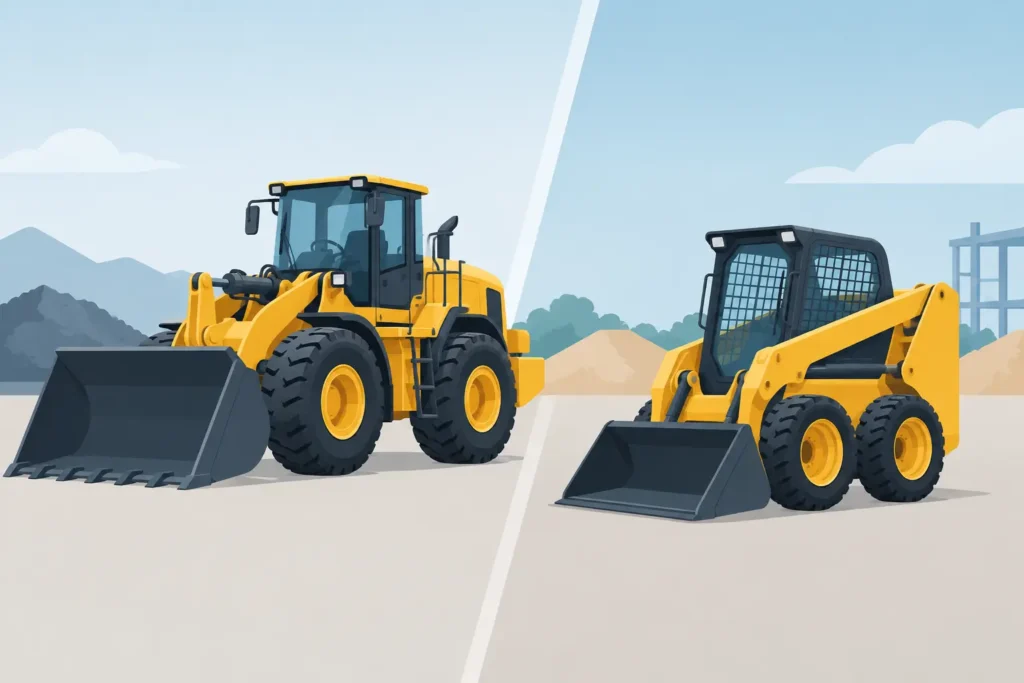
A wheel loader versus skid steer decision can change how quickly your crew loads trucks, moves aggregate, grades a site, or clears material at the end of a shift. Both machines earn their place on Ottawa-area jobsites, but they solve different problems. Choosing by rental rate alone can leave you with a machine that is too small for the material pile or too large for the access points.
The right choice comes down to the work in front of you: material volume, travel distance, available space, ground conditions, attachment needs, and how often the machine will move during the day. A wheel loader is built for production and carrying capacity. A skid steer is built for access, versatility, and tight working areas. Knowing where each machine performs best helps keep labor moving and downtime under control.
Wheel Loader Versus Skid Steer for Production Work
A wheel loader is typically the better fit when moving large volumes of loose material is the main task. For loading dump trucks with gravel, topsoil, sand, mulch, snow, or demolition debris, its larger bucket, higher lift capacity, and faster travel speed make a real difference over a full shift.
The operator can carry more per pass and cover greater distances around an open site without constantly repositioning. That matters on commercial developments, roadwork, quarry-style material handling, lot grading, and larger landscaping operations. When a truck is waiting to be loaded, a machine that needs fewer cycles helps protect the schedule.
Wheel loaders also give operators better stability with heavier loads. Their longer wheelbase and machine weight make them well suited to repeated loading work, especially when the material pile is substantial and the haul trucks are larger. A properly sized loader can place material into higher-sided trucks more comfortably than a compact machine working near its limits.
A skid steer can load trucks too, particularly on smaller jobs. But if it is making repeated trips from pile to truck with a small bucket, production can slow down quickly. Fuel use, operator fatigue, tire or track wear, and cycle times all add up when the machine is undersized for the task.
Where a Skid Steer Makes More Sense
A skid steer earns its keep where room is limited and the job changes often. It can work in narrow side yards, compact construction sites, enclosed storage areas, and around existing buildings where a wheel loader may not have the turning room to operate efficiently.
Its compact frame and tight turning radius are major advantages for residential development, landscaping, utility work, site cleanup, and interior demolition support. A tracked skid steer is especially useful on soft, uneven, muddy, or recently graded ground because it spreads its weight over a larger surface area. That can reduce rutting and improve traction where wheeled equipment may struggle.
Attachment flexibility is another reason contractors choose skid steers. One machine can be fitted with a bucket in the morning, pallet forks at noon, and a brush cutter, auger, grapple, or sweeper later in the day. For a crew that handles many smaller tasks rather than one continuous loading operation, that versatility can be more valuable than maximum bucket capacity.
There are limits. A skid steer has less carrying capacity, a shorter reach, and a rougher ride when traveling across uneven ground. It can be highly productive inside a confined work zone, but it is not the most efficient choice for moving hundreds of yards of aggregate across a large property.
Compare the Job Before You Compare the Machine
The best rental or purchase decision starts with the material and the site layout. Dense material such as wet soil, crushed stone, and concrete debris requires more breakout force and payload capacity than dry mulch or light snow. A bucket that looks large on paper can become a problem if the machine cannot safely handle the load.
Travel distance matters just as much. If material must move 200 feet or more between a pile and a truck, the wheel loader’s speed and capacity often justify the larger machine. If the work stays within a tight area and involves frequent turning, the skid steer’s maneuverability may produce better results.
Look at access from the beginning of the job. Measure gates, lanes, overhead clearances, trailer access, and the work zone itself. A wheel loader cannot help productivity if it cannot get to the pile, while a skid steer may fit through a narrow entrance but lack the reach required to load the available trucks.
Ground conditions should not be treated as an afterthought. A wheeled loader performs well on firm, established surfaces and can travel efficiently across larger sites. A tracked skid steer is often a better option on wet clay, loose fill, soft turf, or uneven terrain. On paved surfaces, however, tracks can wear quickly and may require additional care to avoid damage.
Attachments, Reach, and Daily Workflow
Attachments can tip the decision toward a skid steer when the work has several phases. Pallet forks can move bundled materials, an auger can drill fence or footing holes, and a grapple can handle brush, scrap, or demolition material. Instead of bringing several specialty machines to a smaller job, a skid steer can cover multiple duties with the right attachments and a capable operator.
A wheel loader also accepts specialized buckets, forks, grapples, snow pushers, and material-handling attachments. Its advantage is usually moving more material with each pass. For snow contractors, for example, a wheel loader may be the better production machine for large commercial lots and stockpile management, while a skid steer can clear tight corners, sidewalks, loading areas, and spaces between parked vehicles.
Consider the complete workflow, not only the first task. If the machine will spend most of the day feeding a screener, loading trucks, or building a stockpile, prioritize capacity and reach. If it will switch between cleanup, loading, grading, and handling pallets around a restricted site, prioritize access and attachment compatibility.
Operating Costs and Maintenance Are Part of the Decision
A larger wheel loader generally costs more to rent, transport, fuel, and maintain than a skid steer. That does not automatically make it the more expensive choice. When the loader completes the work in fewer hours, keeps trucks from waiting, and reduces the need for extra machines or labor, its higher daily cost can pay for itself.
The same is true in reverse. Bringing a wheel loader to a small landscaping project can waste money if it spends much of the day idling or waiting for space to work. A skid steer may cost less to operate and be more useful across several smaller tasks.
Maintenance needs should be realistic, especially for owned equipment. Daily inspections of fluids, tires or tracks, pins, bucket edges, hydraulic hoses, and couplers help prevent a small issue from becoming a lost day. Hydraulic leaks, worn tires, damaged tracks, and loose attachment connections should be addressed early. On active jobs, a quick repair response can be the difference between a minor delay and missed trucking or concrete schedules.
Tilling’s Repair Centre Vars supports contractors with job-ready equipment rentals and repair service when loader, skid steer, hydraulic, or attachment issues threaten production. For operators managing multiple machines, having one local source for equipment access and mechanical support simplifies the response when plans change.
Choose the Machine That Removes the Bottleneck
Choose a wheel loader when material volume, truck loading, travel distance, and lifting capacity are driving the job. It is the production choice for open sites where moving more material per pass keeps the entire operation moving.
Choose a skid steer when access is tight, conditions are soft, attachments are central to the work, or the crew needs one compact machine for several different tasks. It is often the practical choice for smaller, more detailed work where maneuverability matters more than bucket size.
Before scheduling equipment, walk the site, identify the slowest part of the workflow, and size the machine to that bottleneck. The right machine is the one that keeps trucks, operators, and the next phase of the project from waiting.